
Blog Post
Blog Details
AI Automation in the Pharmaceutical Industry: Use Cases & Benefits
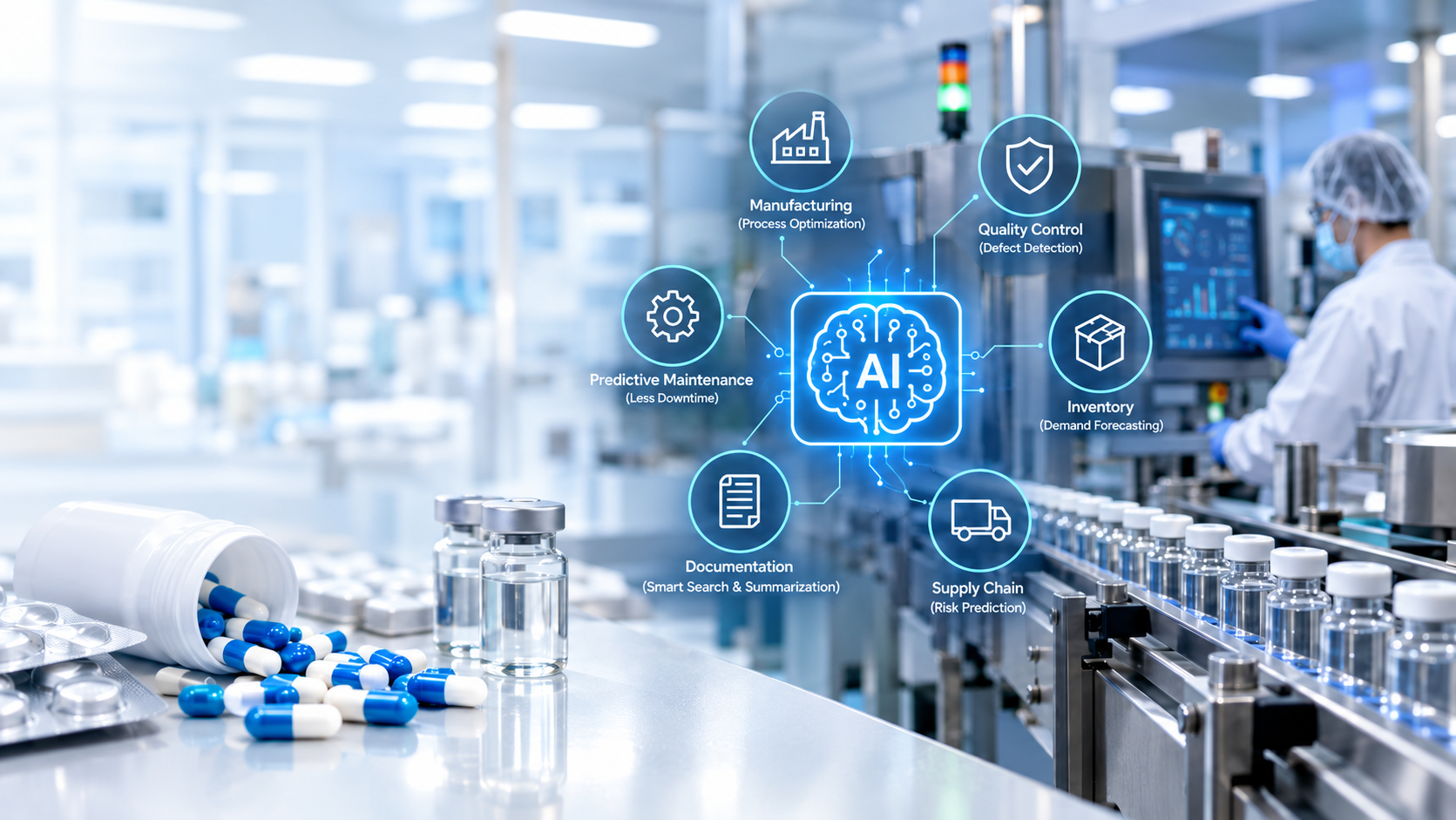
Discover how AI automation is transforming the pharmaceutical industry through smarter manufacturing, quality control, inventory management, and supply chain operations. Explore practical use cases, benefits, challenges, and implementation strategies for pharma businesses.
AI Automation in the Pharmaceutical Industry: Use Cases, Benefits, and Implementation Strategies
The pharmaceutical industry is undergoing a digital transformation. Pharmaceutical manufacturers must maintain product quality, meet regulatory requirements, manage complex supply chains, and improve operational efficiency. At the same time, manual processes, disconnected systems, and growing volumes of data can make daily operations increasingly challenging.
This is where AI automation in the pharmaceutical industry can make a difference.
Artificial intelligence (AI) enables software to analyze data, recognize patterns, generate insights, and assist with complex tasks. When combined with traditional automation and existing business systems, AI can help pharmaceutical companies improve manufacturing visibility, streamline documentation, optimize inventory, and support better decisions.
However, AI is not a replacement for every pharmaceutical process. Its suitability depends on the intended use, data quality, risk level, and applicable regulatory requirements.
In this article, we explore practical AI automation use cases, their potential business benefits, implementation challenges, and strategies for adopting AI responsibly.
What Is AI Automation in the Pharmaceutical Industry?
AI automation combines artificial intelligence with software, machines, and business workflows to perform or assist with tasks that traditionally require manual effort or human analysis.
Traditional automation follows predefined rules. For example, an inventory system may send an alert when stock falls below a specified quantity.
AI-powered automation can analyze historical demand, supplier lead times, seasonal patterns, and current stock to estimate future requirements and recommend replenishment.
Common technologies include:
Machine learning: Analyzes data to identify patterns and generate predictions.
Computer vision: Analyzes images to help identify visual defects or packaging problems.
Natural language processing: Extracts and organizes information from documents and reports.
Generative AI: Assists with summarization, drafting, and searching approved business information.
Robotic process automation: Automates repetitive, rule-based administrative tasks.
Industrial analytics: Uses equipment and sensor data to monitor processes and identify unusual conditions.
The objective is to make pharmaceutical operations more efficient, consistent, and data-driven while maintaining appropriate human oversight.
1. AI in Pharmaceutical Manufacturing
Pharmaceutical manufacturing involves controlled processes such as mixing, granulation, tablet compression, coating, filling, and packaging, depending on the product.
AI and machine learning can analyze production data to identify unusual patterns, monitor equipment performance, and support process optimization.
Potential applications include:
Monitoring production parameters.
Detecting unusual process trends.
Predicting equipment maintenance requirements.
Analyzing production yield and downtime.
Supporting investigations into recurring process deviations.
Practical example: A tablet manufacturer experiences inconsistent production times across batches. An analytics system examines historical equipment and process data and identifies a recurring pattern associated with longer processing times. Production engineers can investigate the finding and determine whether corrective action is appropriate.
AI does not automatically guarantee better manufacturing outcomes. Systems that influence critical production parameters require suitable evaluation, authorization, and controls.
2. AI-Powered Pharmaceutical Quality Control
Quality control is essential because medicines must meet established specifications for identity, strength, purity, and other relevant quality attributes.
Computer vision can assist with visual inspection of tablets, capsules, vials, bottles, cartons, and labels.
Potential applications include:
Identifying cracked or discolored tablets.
Detecting damaged packaging.
Flagging missing or misaligned labels.
Checking printed information and barcode readability.
Identifying unusual visual patterns for further inspection.
Practical example: A pharmaceutical company uses a computer vision system to inspect medicine bottles on a packaging line. The system flags bottles with potentially misaligned labels or missing printed information for handling according to the approved inspection process.
AI-assisted inspection can improve consistency and help teams identify recurring issues. However, the system must be evaluated for its intended purpose. It cannot replace required laboratory testing, quality procedures, or authorized product-release decisions.
3. AI for Pharmaceutical Inventory Management
Inventory management is a practical starting point for AI adoption because it directly affects working capital, product availability, and expiry-related losses.
Traditional inventory software tracks quantities, batches, and expiry dates. AI can complement these capabilities by analyzing historical demand, consumption patterns, supplier lead times, and seasonal variations.
Key applications include:
Forecasting demand for medicines and raw materials.
Identifying slow-moving or excess inventory.
Predicting potential stock shortages.
Highlighting products approaching expiry.
Recommending replenishment quantities for review.
Identifying discrepancies between recorded and observed stock.
Practical example: A pharmaceutical distributor manages hundreds of products across multiple warehouses. An AI-assisted forecasting system identifies a likely increase in demand for selected products and compares the forecast with available inventory and supplier lead times. It alerts the inventory manager to review replenishment requirements.
This approach can support better stock planning, although forecasts remain estimates and must be reviewed against actual business conditions.
4. AI Automation for Pharmaceutical Documentation
Pharmaceutical businesses maintain extensive documentation, including standard operating procedures (SOPs), batch records, deviation reports, audit documents, and training materials.
AI-assisted document processing can help reduce repetitive administrative work.
Common applications include:
Extracting information from approved document templates.
Classifying documents by department or type.
Searching internal SOPs and policies.
Summarizing reports for initial review.
Comparing document versions.
Preparing draft investigation summaries.
Identifying missing fields or incomplete records.
Practical example: A quality assurance employee needs to find the approved procedure for handling a specific deviation. An internal AI assistant retrieves the relevant controlled document and identifies the applicable section so the employee can review the original source.
AI may also prepare a first draft of an investigation summary from approved records. A qualified employee must verify the facts and conclusions before approval.
AI should not invent missing evidence or independently approve regulated documentation.
5. AI in Pharmaceutical Supply Chain Management
Pharmaceutical supply chains depend on coordination among suppliers, manufacturers, warehouses, distributors, and logistics partners.
Unexpected demand, supplier delays, and transportation problems can affect production schedules and product availability.
AI-powered analytics can help businesses assess these risks using procurement records, sales history, supplier performance, and logistics data.
Applications include:
Demand and procurement forecasting.
Supplier performance analysis.
Early warnings for potential shortages.
Shipment delay prediction where suitable data is available.
Monitoring temperature-sensitive shipments.
Identifying distribution inefficiencies.
Practical example: A manufacturer notices that a supplier's delivery times have become increasingly inconsistent. An analytics system highlights the trend, allowing procurement managers to evaluate alternative suppliers, safety stock, and production schedules.
For temperature-sensitive medicines, automated monitoring can flag excursions against approved limits. Authorized personnel must assess the event according to applicable procedures before deciding on the product's suitability.
6. AI-Powered Predictive Maintenance
Equipment failures can interrupt production, increase maintenance costs, and require additional investigations.
Predictive maintenance uses equipment data, including vibration, temperature, operating hours, and historical failures, to estimate when maintenance may be necessary.
Potential applications include monitoring pumps, motors, HVAC components, packaging machinery, and other suitable equipment.
Practical example: A packaging machine begins showing unusual vibration patterns. An analytics system raises a maintenance alert, allowing the engineering team to inspect the machine before a potential failure causes an unplanned stoppage.
Predictive maintenance depends on reliable sensor data, appropriate models, and effective maintenance procedures. It complements rather than automatically replaces scheduled maintenance.
7. AI in Regulatory Intelligence and Pharmacovigilance
Pharmaceutical companies must monitor regulatory information, maintain documentation, and manage product safety reports.
AI tools can assist with searching regulatory documents, classifying information, summarizing relevant updates, and extracting details from adverse event reports.
For example, an AI-assisted monitoring system can flag a new regulatory publication that may affect a particular product or market. A regulatory affairs specialist then verifies the source, assesses its applicability, and determines the appropriate action.
In pharmacovigilance, AI can assist with case processing and information extraction. However, safety reports must receive appropriate review, and AI systems must not independently dismiss potential safety information or replace applicable reporting responsibilities.
Key Business Benefits of AI Automation in Pharma
When implemented for a well-defined business problem, AI automation can offer several potential benefits.
Reduced repetitive work: Automated document classification, data extraction, and routine reporting can free employees to focus on more complex tasks.
Improved operational visibility: Production monitoring and analytics can help teams identify unusual trends earlier.
Better inventory planning: Demand forecasts and expiry-risk alerts can support replenishment decisions and reduce avoidable stock imbalances.
More consistent inspection: Suitable AI-assisted visual inspection systems can help detect specified defects consistently.
Faster access to information: Internal AI search tools can help employees find relevant approved documentation.
Improved maintenance planning: Equipment analytics can help maintenance teams prioritize inspections and reduce certain unexpected disruptions.
These benefits are not guaranteed. Businesses should establish baseline measurements and verify actual results through controlled pilots.
How to Implement AI Automation in a Pharmaceutical Business
A successful implementation starts with a business problem, not simply a decision to adopt AI.
Step 1: Identify a High-Priority Problem
Choose a measurable challenge, such as manual inventory reconciliation, document classification, repetitive reporting, or maintenance alerts.
Step 2: Assess Data Quality
Review data completeness, accuracy, accessibility, ownership, and compatibility with existing systems. Poor-quality data can undermine model performance.
Step 3: Select the Right Technology
Use conventional automation for predictable, rule-based tasks. Consider AI when pattern recognition, forecasting, image analysis, or document understanding adds value.
Step 4: Run a Controlled Pilot
Test the solution on a limited workflow using representative data. Compare its performance with the existing process and define acceptable error rates.
Step 5: Establish Validation and Governance
For regulated applications, assess intended use, risk, data integrity, access controls, audit trails, change management, and validation requirements as appropriate.
Step 6: Measure Results and Scale Gradually
Track accuracy, processing time, operational impact, and errors. Train users and expand the solution only when it demonstrates acceptable performance and the required approvals are in place.
The US Food and Drug Administration's January 2025 draft guidance on AI used to support regulatory decision-making for drugs and biological products proposes a risk-based approach to assessing model credibility in a defined context of use. It is draft guidance, not a blanket authorization for AI systems.
Challenges of AI Adoption in the Pharmaceutical Industry
Despite its potential, AI adoption requires careful planning.
Data quality and integration: Information may be scattered across legacy systems, spreadsheets, laboratory software, and production equipment.
Regulatory compliance: Companies must assess whether a system affects regulated activities and apply appropriate validation and oversight.
Data security: Product formulations, manufacturing records, supplier agreements, and patient-related information may be sensitive. Access controls and appropriate security safeguards are essential.
Accuracy and explainability: AI can miss important events, produce false alerts, or generate incorrect summaries. Employees need ways to verify outputs against reliable source records.
Employee training: Teams must understand system limitations, escalation procedures, and when manual review is required.
Implementation costs: Integration, validation, infrastructure, training, and maintenance can require significant investment. Businesses should evaluate expected value before expanding deployment.
WHO guidance on AI for health emphasizes responsible governance, transparency, privacy, data quality, and risk management.
The Future of AI Automation in Pharma
Several developing capabilities could influence pharmaceutical operations in the coming years.
AI agents for business workflows: AI agents may coordinate multi-step tasks, gather information from approved systems, prepare reports, and route work for review. In regulated environments, permissions and approval checkpoints are essential.
Digital twins: Virtual representations of physical equipment or processes can help engineers explore scenarios and improve process understanding when supported by suitable data and models.
Generative AI for technical knowledge management: Internal assistants can search approved SOPs, training materials, and quality documentation, helping employees locate information faster.
These capabilities are developing at different rates. Monitoring, predictive analytics, and computer vision have established industrial applications, while increasingly autonomous decision-making in regulated pharmaceutical operations requires careful evaluation, controls, and evidence.
Conclusion: Building a Smarter Pharmaceutical Business With AI
AI automation offers pharmaceutical companies opportunities to improve manufacturing visibility, quality oversight, inventory planning, documentation, maintenance, and supply chain management.
The best approach is to begin with a specific operational challenge, assess whether AI is appropriate, evaluate the available data, and implement a controlled solution with measurable objectives.
For example, a pharmaceutical manufacturer could begin with AI-assisted document search or inventory forecasting before evaluating more complex applications that influence production or quality decisions.
Every implementation should prioritize product quality, patient safety, data integrity, applicable regulations, and human accountability.
The real value of AI in pharma is not simply completing tasks faster. It is helping pharmaceutical teams make better-informed decisions, identify problems earlier, and build more reliable operations.
Frequently Asked Questions
1. What is AI automation in the pharmaceutical industry?
AI automation combines artificial intelligence with software, data, and business workflows to assist with tasks such as production monitoring, quality inspection, demand forecasting, document processing, and predictive maintenance.
2. How is AI used in pharmaceutical manufacturing?
AI can analyze production data, identify unusual patterns, support visual inspection, predict maintenance needs, and provide insights into manufacturing performance. Regulated applications require appropriate evaluation and controls.
3. Can AI improve pharmaceutical quality control?
Yes. AI-based image analysis and anomaly detection can help identify potential defects or unusual trends. However, these systems cannot replace required laboratory testing, quality procedures, or authorized release decisions.
4. How can AI help pharmaceutical inventory management?
AI can forecast demand, highlight potential shortages, analyze slow-moving inventory, and identify products approaching expiry. These insights can support procurement and replenishment decisions.
5. Is AI automation suitable for small and medium-sized pharmaceutical companies?
Yes. Smaller companies can begin with focused applications such as document classification, internal knowledge search, inventory alerts, and routine reporting. The best starting point depends on operational needs, data availability, risk, and budget.
6. Does AI automation replace employees in pharma?
AI can reduce repetitive work and assist with analysis, but employees remain essential for technical judgment, quality oversight, investigations, regulatory decisions, and exception handling.
7. What are the main challenges of AI implementation in pharma?
Common challenges include data quality, integration with existing systems, validation requirements, information security, model accuracy, employee training, and demonstrating a measurable return on investment.
8. Is AI allowed in pharmaceutical manufacturing?
AI is not universally prohibited, but its suitability depends on the intended use, jurisdiction, and applicable regulatory requirements. Relevant applications may require risk assessment, validation, documentation, and human oversight.
9. What is the difference between traditional automation and AI automation?
Traditional automation generally follows predefined rules. AI can additionally recognize patterns, analyze unstructured information, classify images, or generate predictions. Many business solutions combine both approaches.
10. How should a pharmaceutical company start using AI?
Begin by selecting a measurable business problem, assessing available data, choosing suitable technology, conducting a controlled pilot, and evaluating results. Regulated applications require appropriate risk assessment and controls.
References and Further Reading
World Health Organization: Benefits and Risks of Using AI for Pharmaceutical Development and Delivery (2024).
https://www.who.int/westernpacific/publications/i/item/9789240088108US Food and Drug Administration: Considerations for the Use of Artificial Intelligence to Support Regulatory Decision-Making for Drug and Biological Products (2025 draft guidance).
https://www.fda.gov/regulatory-information/search-fda-guidance-documents/considerations-use-artificial-intelligence-support-regulatory-decision-making-drug-and-biologicalUS Food and Drug Administration: Artificial Intelligence in Drug Manufacturing.
https://www.fda.gov/media/165743/download?attachment=
Disclaimer: This article is for general informational purposes. Regulatory obligations vary by jurisdiction and application. Verify current requirements before implementing AI in regulated pharmaceutical processes.
Related Blog
What to read next


Let's Start
Initiating Your Journey to Success and Growth.